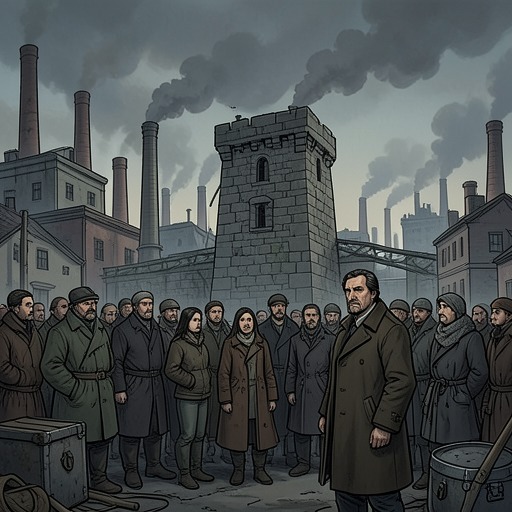
Louis XI
The Hunchback of Notre DameLouis XI is a largely offstage but consequential ruler in The Hunchback of Notre-Dame: his authority shapes the political pressures surrounding Paris, while his personal dealings reveal a king who uses secrecy, patronage, and carefully managed appearances. He is not simply a distant sovereign. His reach is felt in the city’s competing jurisdictions, the careers of powerful churchmen and royal advisers, and the sentence that threatens Esmeralda.
Identity and Political Setting
In the opening account of January 6, 1482, Louis XI is part of the political background to a day whose public commotion has another cause: the combined observance of Epiphany and the Feast of Fools. Two days earlier, Flemish ambassadors had entered Paris to arrange a marriage between the dauphin and Marguerite of Flanders. Their reception had obliged Charles de Bourbon to perform cordiality toward the envoys, illustrating how royal policy could press upon even a high-ranking churchman’s public conduct.
Charles de Bourbon’s position also shows the delicate network around the king. He was related to Louis XI through his brother, who had married the king’s eldest daughter, and to Burgundy through his mother. The narrator describes Charles as a courtier devoted to those in power, forced to steer between rival political forces. His predicament gives the king’s court a defining atmosphere: closeness to the crown confers influence, but also makes political loyalties difficult to navigate.
The account contrasts royal authority with the force of popular leaders. During the Feast of Fools, Jacques Coppenole, a Flemish hosier, commands the attention of the crowd and is described as feared by Louis XI. His standing rests not on an inherited title but on his ability to move people: the narrator credits him with having stirred Ghent’s populace against powerful favorites. The contrast makes royal power look neither absolute nor uncontested; a merchant with popular support can represent a force that even the king must reckon with.
Rule Over a Divided Paris
The city Louis XI rules is divided into three distinct parts: the City, the Town, and the University. Each has its own character and institutions, while authority is distributed among the bishop, the provost of the merchants, the rector, and the king’s provost of Paris. This arrangement makes royal government part of a crowded legal landscape rather than a single, seamless system. The king’s officer stands above the municipal divisions, but the different bodies retain privileges and local power.
The jurisdictional divisions have practical consequences. Scholars accused of offences on the left bank could be tried on the island and punished on the right bank at Montfaucon, unless the rector intervened under the university’s privileges. Those privileges, the narrative explains, had often been won through revolt and mutiny. Paris is therefore presented as a place where royal authority coexists with, and is repeatedly tested by, institutional rights secured through collective resistance.
Louis XI’s policy toward sanctuary further complicates the relationship between royal power and local justice. In 1467 he made all Paris a place of refuge. A person who entered sanctuary was protected there, but safety depended on remaining within its bounds; outside, the ordinary threat of punishment returned. The narrator stresses that asylum could function like a prison as well as a protection. The king’s citywide grant thus offered refuge while leaving those who sought it confined by the boundaries that made it effective.
Secrecy, Counsel, and Court Influence
Louis XI’s private encounter with Claude Frollo reveals the king operating under an assumed identity. He arrives at Frollo’s cell accompanied by Jacques Coictier and presents himself as a provincial gentleman called Gossip Tourangeau, seeking the learned man’s advice. His appearance and manner do not immediately identify him to Frollo; recognition comes only after the visitors have left, when Frollo connects the name Abbé de Sainte-Martin of Tours with a royal title recorded in the register of that church.
The meeting becomes the beginning of a continuing political relationship. Louis XI invites Frollo to the Palais des Tournelles the following day, directing him to ask for the Abbé de Sainte-Martin of Tours. The narrator later reports that the two held frequent conferences when the king was in Paris. Frollo’s influence eventually overshadowed that of Olivier Le Daim and Jacques Coictier, and Coictier responded by openly taking the king to task. The episode links the king’s secrecy to his methods of counsel: access to him could redirect influence at court, provoking resentment among those already close to the crown.
Political Calculation and Consequence
The narrative also attributes a covert act of political violence to the king’s circle. In a retrospective account, it says that wine Louis XI offered to Edward IV had been altered by Jacques Coictier and would eventually rid the French king of the English monarch. The detail complicates the image of Louis as a ruler who relies only on public office and formal alliances. His power also operates through private arrangements whose consequences are concealed from their intended target.
Louis XI’s authority appears again in the sentence imposed on Esmeralda. The court condemns her and her goat, orders a public act of penance before Notre-Dame Cathedral, and sets her execution at the king’s pleasure. The sentence is delivered by the court, not personally pronounced by Louis in the cited scene, but its timing is expressly left to royal discretion. In this way the king’s power enters the plot as the final temporal authority over a punishment produced by the city’s legal machinery.
Narrative Significance
The novel gives Louis XI no sustained personal viewpoint, but builds his presence through reports, disguises, appointments, and delegated power. His influence reaches into church politics through Frollo, into the life of the court through advisers such as Coictier, and into the city’s legal order through royal jurisdiction and control over the timing of punishment. Against that reach stand the privileges of institutions, the protections and limits of sanctuary, and the unpredictable force of popular figures such as Jacques Coppenole.
This indirect portrait makes the king both an individual strategist and the emblem of a monarchy working within a fragmented city. The same ruler who can establish Paris as a refuge is also associated with an execution whose timing rests at his discretion. Royal authority can shelter, influence, or condemn, but it does not erase the other powers through which medieval Paris is governed. The tension between centralized command and divided jurisdiction gives Louis XI’s brief appearances their larger political significance.